The Myth of Total Automation: What AI Can't (Yet) Decide for You in Live Video Production
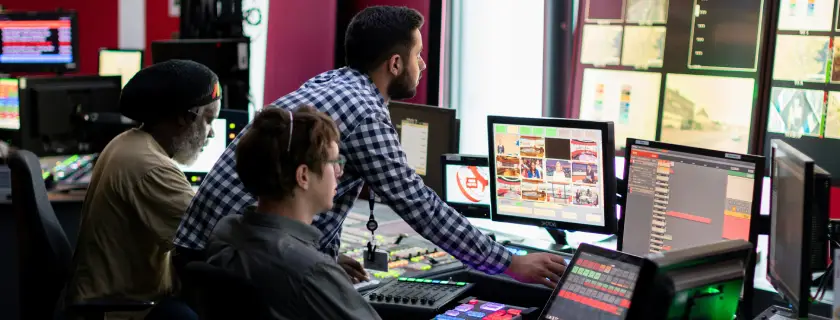
For the past two years, the conversation around AI in live video production has followed the same script: automatic detection of key moments, highlights published without human intervention, and social media teams freed from repetitive tasks. The promise is appealing.
But in newsrooms, editorial teams, and social media units that work on real-time live feeds (breaking news, institutional events, conferences, sports competitions), one observation comes up time and again: the complete automation of live clipping remains difficult to achieve, and the limitations we face today are not all simply technical issues waiting to be resolved.
This article encourages readers to ask the right questions about what automation can actually do, and to understand why human editorial judgment remains irreplaceable in live situations.
Why AI-powered automation of live video clipping is (very) much in the spotlight, but the reality is more nuanced
What the market highlights: automatic detection, instant highlights, no human intervention
In recent years, the industry has heavily promoted AI’s ability to detect key moments in a live broadcast, cut them out, format them, and publish them without human intervention. This promise is driven by a rapidly growing market and is based on real capabilities
Models trained on corpora of matches, debates, or conferences can effectively identify recurring patterns: a goal, applause, a rise in sound level, a spoken keyword, or a transition jingle.
These capabilities are often accompanied by claims that they are sufficient to handle a complete live workflow—from ingest to publication—with minimal human oversight. This argument appeals to management teams looking to streamline their short-form content production without increasing headcount.
What editorial teams who use it every day actually say
In reality, teams on the ground report a more nuanced situation. AI effectively automates tasks involving strong signals: a recognizable jingle, a predictable audio peak, or a pre-tagged timecode. But as soon as the live broadcast deviates from the expected pattern (and it is the very nature of live broadcasting to do so regularly), fully automated systems reach their limits: the generated clips may be technically correct, but editorially off the mark, or even missing where it really mattered.
It’s not a matter of computing power or model version. It’s a matter of nature: AI recognizes patterns; it doesn’t understand meaning. And in real-world situations, meaning is often where patterns are lacking.
“All content generated by AI must be fact-checked. It is a support tool, not a substitute.” Frédéric Zalac, journalist, ICI Radio-Canada Télé
Key takeaway: In 2025, the European Federation of Journalists (EFJ) formally reiterated that human editorial oversight remains non-negotiable, even in AI-assisted workflows (source).
The 4 situations where AI-driven automation of live clipping is limited: why it’s structural, not technical
The limitations described here are not bugs to be fixed in the next version of a model. They are inherent to what AI does: learning to recognize what it has already seen. When dealing with live situations, which are by definition unpredictable, these limitations are common.
1. Off-script moments: when the live performance deviates from what the AI has been trained to recognize
An automatic detection model is trained on historical data. It learns to recognize a goal, a crowd reaction, an opening statement, or thunderous applause. What it struggles to anticipate are moments that have no clear precedent in its corpus: an unexpected statement by a speaker, a technical glitch that becomes iconic, or a commentator’s spontaneous emotional reaction that shifts the mood of the entire venue.
The most advanced models are making progress in this area, particularly through transcription: when analyzed as text, an unscripted moment can be detected by contrast with the rest of the speech. However, this capability does not yet apply with the same reliability to audio, visual, or gestural cues. In live settings, where speed is non-negotiable, these limitations matter.
However, these unscripted moments are often the most important from an editorial standpoint. They are exactly what social media teams are looking for above all else. This is precisely where automation remains the least reliable: not because the AI is poorly configured, but because detecting the unexpected—across all platforms—is never 100% guaranteed.
2. Irony, humor, and sarcasm: the nuances that detection models have the most trouble picking up on
AI analyzes signals: audio peaks, keywords, periods of silence, and chat activity levels. It does not perceive tone of voice. It does not realize that a sentence spoken in a neutral tone is, in fact, a scathing criticism. It cannot distinguish between a knowing laugh and a collective sense of unease. It fails to detect the irony in a seemingly innocuous statement.
This disconnect between signal and meaning creates two types of symmetrical risks: the risk of missing a key moment (the soundbite that makes the next day’s headlines) and the risk of publishing a clip out of context that could backfire on the media brand or organization sharing it. In both cases, it is human judgment that makes the difference, not the model’s accuracy.
Key takeaway:A technically flawless video that is editorially inappropriate can do more harm than good. Speed is meaningless without substance.
3. Editorial prioritization: choosing among several simultaneous highlights
In a multi-stream event (multiple concurrent conferences, simultaneous matches, or several live segments airing at the same time), AI can detect dozens of potentially newsworthy moments all at once. However, it cannot determine which one is THE key moment of the day for your brand, your editorial line, or your target audience.
This prioritization decision is fundamentally editorial. It depends on the media outlet’s editorial stance, the current context, the topics being covered, and the audience’s sensibilities. No configuration parameter can account for this contextual intelligence. That is why human operators remain indispensable, especially in environments with a very high volume of simultaneous traffic.
4. Branding and brand consistency: what a shared context alone cannot guarantee
A video clip may be technically flawless (well-edited, well-framed, subtitled, and styled) yet completely unsuitable for the editorial guidelines of a media outlet or organization. The tone may be too informal for an institutional channel. The subject matter may be politically sensitive for a broadcaster during an election season. The speaker may be at odds with the brand’s positioning.
AI tools now allow for the integration of contextual information: desired tone, editorial filters, branding guidelines, and selection criteria. These parameters guide the model’s choices and significantly improve the relevance of its suggestions. But they do not guarantee them. AI relies on what it is given; it does not perceive what we have forgotten to tell it, nor what the current context suddenly renders inappropriate.
These subtle judgments remain a human responsibility. They require an intimate understanding of the publication’s editorial identity, its history of engagement with sources, and the context in which the publication is set—knowledge that is constantly evolving and that no preset can fully capture.
Key takeaway:Brand consistency is partly defined by guidelines, but it is always validated by human judgment, as it is a form of editorial insight developed over time.
Automation of detection vs. automation of decision-making: the distinction your live workflow must make
The debate on AI in live clipping suffers from a harmful confusion of terminology: automation is treated as a single, homogeneous concept, when in reality it encompasses two radically different areas: the automation of detection and the automation of decision-making.
This distinction is not merely semantic; it is practical. Clarifying this distinction allows us to build a live workflow that makes the most of AI without delegating tasks it cannot perform.
What AI does better than you: jingle detection, detection of key moments, bulk processing
In high-signal detection tasks, AI models are objectively superior to human operators in terms of speed, consistency, and resistance to fatigue. Here are the tasks they handle with proven reliability:
- Jingle detection: automatic identification of recurring audio markers (segment start and end, theme music, intro) to generate instant clips without manual intervention.
- Identifying moments with potential: continuous analysis of audio and video streams to flag sequences that match predefined criteria (sudden spikes in sound intensity, spoken keywords, increased chat activity, changes in visual rhythm). The AI does not decide whether a moment is worth publishing, but it extracts it and makes it available to editorial teams.
- Consistent execution of repetitive tasks: subtitling, automatic cropping, applying branding templates, and multi-format export. The AI applies the same settings to the 100th clip as it does to the first, without variation, without omission, and without cutting corners out of fatigue. What a human might do well on 5 clips, the AI does identically on 500.
- High-volume processing: Across numerous parallel streams, AI continuously monitors areas where a single human cannot maintain constant attention.
These features aren't just gimmicks. They deliver real operational time savings, freeing teams from routine tasks so they can focus on what only they can do.
What only a journalist can do: provide context, set priorities, and uphold editorial standards
Conversely, here is what human judgment brings to the table, something that no automation can replace at present, nor in the near future:
- Put it into context: understand why this moment matters now, in the current climate, to this specific audience.
- Prioritize: decide, among several opportunities identified at the same time, which one deserves to be addressed first and from what angle.
- Protecting editorial integrity: assessing whether a video aligns with the brand’s identity, the outlet’s tone, and the current climate.
- Reading between the lines: picking up on the irony, humor, tension, and subtext in speech—where audio and textual cues fall short.
- Anticipating reputational risk: assessing whether the release of a video clip could lead to misunderstanding, controversy, or misinterpretation.
The value of an editorial team isn't measured by the number of clips produced per hour. It's measured by the quality of the decisions made under pressure, in real time, in areas where AI still can't go.
Which live clipping tool should you choose when you want speed without losing editorial control?
The question is no longer: “Is my live clipping tool automated enough?” It is: “Is my live clipping tool designed so that automation supports human judgment, rather than bypassing it?”
This shift in perspective fundamentally changes the criteria used to evaluate a solution. Here are the three factors that really matter to an editorial or social media team in real-time situations.
The 3 criteria to consider before adopting a live clipping tool in the newsroom
1. The learning curve and real-world adoption. A tool that requires extensive technical training or broadcast expertise to operate live will not be used under pressure. How quickly non-technical teams adopt a solution is an indicator of operational quality, not a sign of a lack of capability. The best solutions are the ones that teams actually use, not the ones with the longest list of features.
2. The balance between useful automation and preserved editorial control. Carefully assess what the tool automates and what it leaves to human judgment. A good live clipping tool should automate detection, cutting, captioning, and reformatting, while leaving the decision to publish, the timing, and the choice of angle to the operator. If the tool pushes to delegate these decisions as well, it introduces an editorial risk that speed cannot compensate for.
3. Reliability under real-world conditions. Demos in a controlled environment don’t tell you much. What matters is the stability of the stream under adverse conditions (network latency, unstable stream, peak load), the responsiveness of support in the event of a live incident, and the tool’s ability to hold up over the duration of a long event: a conference lasting several hours, a late-night live broadcast, or multiple simultaneous streams.
Why the right balance isn’t "more AI"but "smarter AI integration"
The question isn't whether AI should play a bigger role in your live workflow. It's about identifying exactly where in the process AI adds value and where it introduces risks that your team doesn't have time to monitor under pressure.
Smarter AI integration means using automation where it is reliable and liberating: detection, clipping, subtitling, and multi-format reformatting. It means refusing to rely on it where it is structurally limited: contextualization, prioritization, and safeguarding editorial integrity.
This is the workflow architecture that Yuzzit has built: not a tool that makes decisions for you, but one that turns your decisions into actionable steps in just a few minutes: without friction, without delays, and without compromising the value of your editorial work.
Control the Speed. Not at any editorial cost.
Frequently Asked Questions
Share this article

.webp)

Subscribe to our newsletter!
Get our latest news and valuable tips for creating your videos!
Sign up now for our Yuzz’letter!
Our Latest Articles

Presidential Campaign: How to Respond Within Minutes to Every TV and Radio Appearance

Radio: From Live Broadcasts to Published Clips—The Best Step-by-Step Workflows