Switching from manual video editing to live clipping for social media
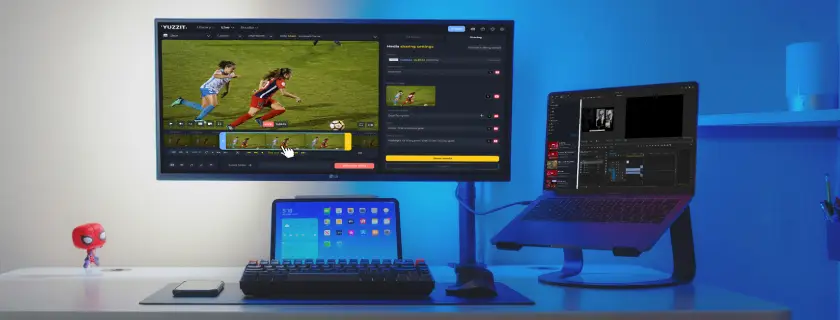
For a long time, manual video editing structured the production of social content. A live broadcast was aired, then used retrospectively via excerpts edited in post-production.
This model remains relevant in certain contexts. However, with the acceleration of social media use and the dominance of short formats, it is now reaching its limits.
More and more teams are asking themselves a very practical question: should they continue to edit after the fact, or switch to live clipping for social media? Don't hesitate any longer and find out why in this article!
Manual video editing and live clipping: two fundamentally different approaches
Manual video editing is based on a post-production approach. The work begins once the event is over, using a replay or exported files.
This approach prioritizes finishing, precision, and control. However, it involves delays, heavy reliance on post-production, and often centralized organization.
Live clipping works in the opposite way. Clips are created directly from the live stream while the event is still in progress.
Production becomes simultaneous with distribution. Publication takes place in real time.
This change in timing profoundly alters performance on social media.
This table does not compare two levels of quality. It compares two production logics for social networks, where the time of publication determines visibility.
What it shows is that live clipping is better suited to current uses.
Why manual video editing has its limitations for social media
Social platforms favor content published at the right time. Visibility depends heavily on the ability to join an ongoing conversation.
With a manual editing workflow, there is inevitably a delay between what happens live and what is published.
This discrepancy often leads to:
- a decline in organic reach,
- less commitment,
- a loss of editorial opportunities.
Even a perfectly edited clip can underperform if it arrives too late. In this context, the problem is not quality.
It's timing.
Why live clipping is more effective for social media
Live clipping allows you to publish while the audience is still active. Highlights are captured and broadcast when attention is at its peak.
Every live stream becomes a continuous source of short content, ready to be published on X, Instagram, TikTok, LinkedIn, or Facebook.
This approach allows:
- increase the frequency of publication without increasing production costs,
- increase points of contact with the audience,
- maximize the impact of each live event.
Live streaming is no longer limited to a replay used after the fact. It has become a lever for social media performance.
Moving from manual editing to live clipping: a gradual evolution
Adopting live clipping does not mean abandoning traditional editing. The two approaches remain complementary.
Manual assembly remains valuable for:
- long formats,
- corporate videos,
- content requiring extensive post-production.
Live clipping is essential for:
- short excerpts,
- key moments,
- event and live content.
This breakdown allows teams to choose the right method for the task at hand without disrupting their entire organization.
Signs that it's time to switch to live clipping
In practice, the decision becomes obvious when:
- the clips come after the social conversation,
- post-production slows down publication,
- Live streams have little impact despite a large audience.
- Social teams lack autonomy.
At this point, the problem is no longer isolated. It is structural.
Why Yuzzit is the ideal solution
Yuzzit is a platform specializing in live clipping for social media.
It allows you to:
- capture a live stream,
- create clips in real time,
- publish quickly on social media platforms.
All without going through a cumbersome manual editing workflow. And without compromising existing post-production practices.
This approach facilitates a measurable transition. Teams can test specific events and then make decisions based on concrete results.
Benefits observed after adoption
After a few uses, the findings are generally clear:
- reduction in production time,
- improved editorial responsiveness,
- greater commitment thanks to good timing,
- more autonomous social teams.
Live clipping is becoming an operational reflex. Manual editing is regaining its place where it brings real value.
Conclusion: a choice that has become strategic
As social media platforms favor real-time and short formats, live clipping is emerging as a logical evolution of video editing.
For teams looking to transition from manual video editing to live clipping for social media, testing a dedicated solution is currently the most rational way to decide.
Live clipping is no longer an advanced option. It is becoming a social media standard.
Book a personalized demo of Yuzzit
Try live clipping on your own events and live streams and make your decision based on concrete results, not promises.
Frequently Asked Questions
Can live clipping completely replace manual video editing?
No, and that's not the goal. Live clipping is ideal for short formats, highlights, and real-time social media. Manual editing remains relevant for long formats and highly produced content. The two approaches are complementary.
Does live clipping require more resources or dedicated teams?
On the contrary. Live clipping reduces dependence on post-production. Social media teams can create and publish content themselves, in real time: fewer back-and-forths, fewer bottlenecks, more autonomy.
How can you measure the ROI of switching to live clipping?
The indicators are quickly visible. Reduced production time, increased publication speed, higher engagement. Testing a solution such as Yuzzit allows you to concretely evaluate the benefits before a wider deployment.

Share this article

.webp)

Subscribe to our newsletter!
Get our latest news and valuable tips for creating your videos!
Sign up now for our Yuzz’letter!
Our Latest Articles

Presidential Campaign: How to Respond Within Minutes to Every TV and Radio Appearance

Radio: From Live Broadcasts to Published Clips—The Best Step-by-Step Workflows