Broadcast vs. Social: How to Coordinate Two Teams That Don’t Work at the Same Pace on the Same Live Broadcast
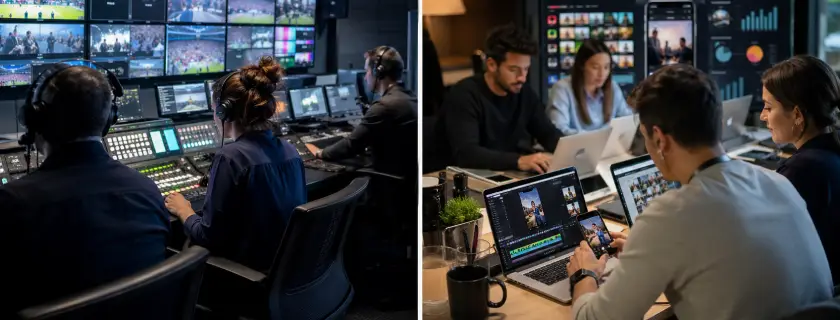
A sporting event, an election, a live concert. On one side, a production team on the job since dawn, a meticulously planned decision-making process, and a workflow designed to ensure the broadcast never goes off the air. On the other, a social media team refreshing its feed every thirty seconds, ready to post that iconic moment before the competition does. These two teams are working on the same live event, yet they operate in completely different worlds.
This isn’t a matter of bad faith. It’s a structural divide: two professional cultures, two different approaches to time, and two different definitions of what it means to “do a good job” on air. This divide comes at a high cost: in lost viewership, in missed opportunities, and in energy spent negotiating rather than producing.
This article outlines the problem, identifies the key tensions, and, most importantly, proposes a practical model to enable these two teams to work together without getting in each other’s way.
Two teams, two timeframes: the invisible divide at the heart of live broadcasting
Broadcast production: a workflow designed for continuity, not responsiveness
The live broadcast editorial workflow is a system designed to ensure signal quality. Every step serves a purpose: filming, production control, approval, and broadcast. This linear process is a success; it allows for hours of live programming without major technical glitches. But it is fundamentally sequential. A highlight enters the workflow just like any other segment: captured, integrated, and archived at the end of the program. The concept of on-the-fly editing does not exist here. In fact, it is structurally undesirable. Any unplanned extraction is perceived as an intrusion into a well-oiled machine.
The social media team: a need for immediate posting that the production line ignores
The digital team operates on a different timeline. Its raw material is the moment. The value of content declines exponentially in the first few minutes following an event: a clip published 10 minutes after the event can generate ten times more engagement than a clip published two hours later, no matter how well produced it may be. For the team, live content is raw material to be transformed in real time—not through technical perfection, but through immediate editorial relevance.
The structural problem is simple: in virtually all broadcast organizations, this team does not have access to the source feed during a live broadcast. It relies on intermediaries to obtain its raw footage. And this reliance is detrimental to its mission.
What this misalignment really costs
Organizations that have begun to measure this cost are finding consistent indicators: engagement rates that are 3 to 5 times higher for clips posted within the first 10 minutes, and a significant number of key moments missed due to lack of access to the live stream. Added to this is a relational cost: this lack of synchronization fuels mutual mistrust, which coordination meetings generally only exacerbate.
The broadcast workflow is designed to run without interruption. That is precisely what makes it so difficult to adapt to the fast-paced nature of social media.
Why the usual answers aren't enough
In response to this tension, three types of solutions have been tested. The “bridge” project manager, a coordinator who shuttles back and forth between the production control room and the social media team. This creates an additional bottleneck and remains a fragile solution: if the manager is absent, the system breaks down. Broadcast editorial planning tools are insufficient for a social media team working under tight deadlines. And native social media tools cannot communicate with the production control room.
The result: two fully equipped ecosystems that do not communicate with each other, reinforcing organizational silos rather than breaking them down. Digital transformation in broadcasting often involves adding another layer of tools rather than redesigning the interfaces between teams.
To move forward, we must start with a simple conviction: broadcast and social media are not at odds with one another. They each have their own legitimate rationale. One safeguards quality and editorial responsibility, while the other champions the immediacy and intelligence of the digital audience. The question is not which one takes precedence, but rather how to create the conditions for them to coexist without hindering one another.
An organizational model that balances broadcast schedules with social responsibilities
Organizations that have managed to overcome this tension have not done so by imposing one culture on the other. Instead, they have created interfaces—areas of contact—where the two approaches coexist without canceling each other out.
Mirror streaming: simultaneous access to sources with differentiated permissions
This model gives the digital team simultaneous access to the broadcast feed, allowing them to work on the content in real time, with clearly defined rights. The social media team views the feed, identifies and selects clips, and prepares them for use. The post can then be submitted to a streamlined approval workflow: a quick approval from an editorial supervisor, ideally automated for predictable events (league goals, official results, scheduled appearances).
This is where tools like Yuzzit come into their own: as a technical bridge between two worlds that didn’t speak the same language. The value of a live clipping tool extends beyond the clipping itself. It lies in its ability to integrate seamlessly into the broadcast workflow without disrupting it, while giving the social media team the autonomy it needs to work at the pace of social-first live content production.
This model strikes a good balance between immediate impact and operational feasibility. It doesn’t require a major organizational overhaul or rare hybrid roles: it’s about providing controlled access to what already exists, while establishing clear rules from the outset. Teams remain within their own scope, culture, and tools, but they finally work on the same content at the same time. For most broadcast organizations that want to move forward without reinventing everything, this is the most direct path to true collaboration.
What the tool should do: serve as a bridge, not add another layer of complexity
To serve as a bridge in a live setting, there are two non-negotiable criteria to consider when choosing your tool.
Criterion 1: Seamless access to the source feed for the non-technical team
A social media team shouldn’t have to configure an encoder or navigate a professional editing interface. If the tool requires several days of training, it will be bypassed in the heat of a live broadcast. Technical complexity must be handled by the tool, not passed on to the user. This is a design principle that seems obvious, yet is consistently underestimated in broadcast environments where a technical culture dominates.
Criterion 2: Output formats tailored to each channel without manual re-encoding
A clip intended for Instagram Reels does not have the same aspect ratio or optimal length as a clip intended for YouTube Shorts or X. If the social media team manually re-encodes each clip for every platform, they waste valuable time and increase the risk of errors. A tool designed for a live broadcast editorial workflow automatically generates the appropriate formats for each destination—from the broadcast feed to publication—with minimal intermediate steps.
Toward a unified live newsroom: what the most advanced organizations have realized
Broadcasters who have most successfully resolved the tension between broadcast teams and digital teams have one thing in common: they didn’t resolve it through top-down directives, nor through tools alone, nor even through formal reorganization. They resolved it through a slow and often uncomfortable evolution of their management culture, based on a simple conviction: in a live broadcast, content doesn’t have just one life—it has many.
It lives on the air, in its original format. It lives on social media, edited, commented on, and shared. It lives in the archives, available for future use. It lives with our partners, rebroadcast in other contexts. Producing content for just one of these uses means leaving value on the table.
The question is no longer “Who publishes?” but “How do the two teams collaborate in real time?”
This shift in focus is the most reliable sign that an organization has moved past the divide. As long as internal discussions center on publication rights or the question of “who approves what,” the organization is managing a conflict. When the discussion turns to co-production workflows, formats, and shared timelines, the organization is in the process of resolving the issue.
This transition requires that leaders—CDOs, production managers, and editorial directors—share a common understanding of the issue. It requires investment in cross-training for teams, in appropriate tools, and in processes that allow the two cultures to interact regularly.
Successful organizations did not try to merge two cultures. Instead, they created a shared workspace where each could remain true to itself and contribute to something that neither could have achieved on its own.
It is under these conditions that live broadcasting becomes what it should always have been: not a one-off event broadcast on a single channel, but a dynamic editorial resource, utilized simultaneously to its full potential by teams that respect one another because they have learned to understand one another.
Frequently Asked Questions
Share this article

.webp)

Subscribe to our newsletter!
Get our latest news and valuable tips for creating your videos!
Sign up now for our Yuzz’letter!
Our Latest Articles

Presidential Campaign: How to Respond Within Minutes to Every TV and Radio Appearance
Radio: From Live Broadcasts to Published Clips—The Best Step-by-Step Workflows